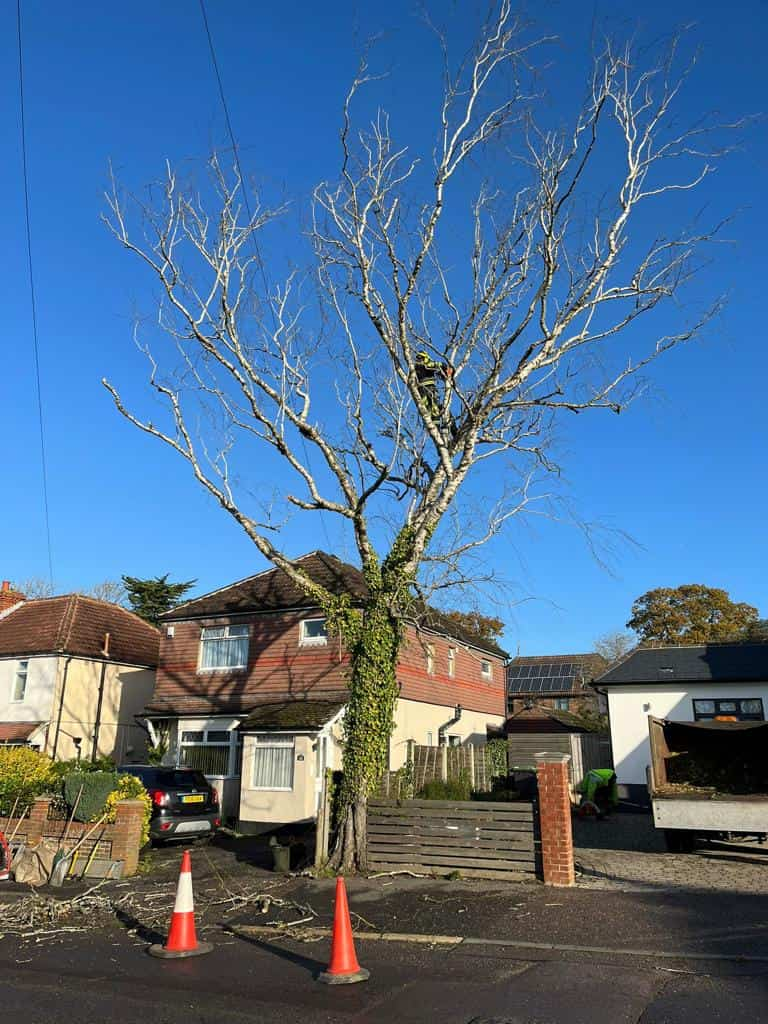
Trees can grow relatively close to a property for many years without creating an obvious problem. However, as the crown continues to develop, branches that were once comfortably separated from the building can gradually extend towards walls, windows, guttering or the roof. Eventually, homeowners may notice foliage brushing against the house or individual branches making direct contact.
For property owners in Roydon, Essex, branches reaching the house are a sensible reason to have the tree assessed. This does not automatically mean that the tree needs heavy pruning or removal. In many situations, carefully selected tree surgery can create suitable clearance while retaining the tree and much of its natural crown. The important step is determining which growth is causing the problem and how it can be managed appropriately.
What Should You Do When Tree Branches Begin Reaching Your Property?
When branches first reach a house, the temptation can be to cut back everything on the property-facing side. However, tree pruning should consider the complete crown rather than treating one side in isolation.
The right approach depends on the size and position of the branches, the species and structure of the tree, how much clearance is required and whether the growth is part of a wider issue with the crown.
Do Not Ignore Repeated Contact With the Building
Occasional contact from light foliage is different from substantial branches repeatedly pressing or rubbing against part of the property.
As branches move naturally in windy conditions, repeated contact can become more noticeable.
It can also indicate that the tree has now reached a size where the relationship between its crown and the available space needs reconsidering.
Professional assessment can establish whether selective pruning is sufficient or whether a broader form of crown management would be more appropriate.
Check Which Part of the Tree Is Actually Causing the Problem
Before deciding that an entire tree has become too large, it is useful to identify where the conflict occurs.
Sometimes only one or two branches have extended towards the building while the remainder of the crown remains well positioned.
In this situation, targeted pruning may provide the required clearance without substantially altering the complete tree.
Where a much larger section of the crown has reached the property, a different approach may need to be considered.
Branches Reaching the Roof Deserve Attention
Branches extending over or towards a roof can become increasingly difficult to manage as they grow.
The problem is not necessarily that the tree is unhealthy. It may simply have expanded into space that is no longer suitable for unrestricted growth.
Selective pruning can sometimes create more separation between the crown and the roof.
The work should be planned around suitable pruning points rather than simply cutting branches wherever they cross an imaginary boundary beside the building.
Growth Around Guttering Can Become Inconvenient
Branches and foliage extending around guttering can contribute to an increasing accumulation of leaves and small organic debris.
Where a tree has grown directly against this part of the property, additional clearance may make routine property maintenance easier.
This does not necessarily require reducing the whole crown.
The relevant branches can be assessed in relation to the tree’s overall structure so that only appropriate growth is removed.
Branches Near Windows Can Reduce Light
As a tree expands towards a property, branches may begin covering or partially obstructing windows.
The resulting reduction in light can become one of the first reasons homeowners consider pruning.
The appropriate solution depends on whether a few branches are responsible or whether the complete crown has become substantially larger and denser.
Selective pruning may be enough where the issue is localised. Where the overall dimensions are responsible, crown reduction may be worth considering.
Branches Can Restrict Access Around the House
Tree growth does not need to touch the building itself to become inconvenient.
Low or spreading branches can reduce access along paths or around frequently used areas close to the property.
Where clearance is the main objective, targeted pruning or appropriate crown lifting may provide a more proportionate solution than reducing the complete tree.
Professional assessment helps identify exactly which branches are affecting access.
Consider How Much the Tree Has Changed
A useful question is whether the contact with the house is new.
If branches were comfortably separated from the property several years ago but are now repeatedly touching it, the tree has clearly outgrown the previous amount of available space.
That does not mean it has become unsuitable.
It may simply indicate that periodic management is now appropriate to maintain a practical relationship between the tree and the building.
Selective Pruning May Be All That Is Needed
Where only particular branches are causing the problem, selective pruning can often be considered.
This involves identifying the specific growth responsible for the conflict and determining suitable points at which it can be shortened or removed.
The advantage of this approach is that unaffected parts of the crown can remain largely unchanged.
Tree surgery should solve the actual problem rather than automatically creating unnecessary work elsewhere in the tree.
Crown Reduction Can Help When the Whole Tree Has Become Too Large
If numerous branches across a substantial part of the crown are approaching the house, removing one or two individual limbs may provide only temporary improvement.
Where appropriate, crown reduction can decrease the overall dimensions of the tree.
Professional crown reduction should retain an appropriate shape and work with the tree’s existing branch structure.
It is not simply a matter of cutting every branch back by the same distance.
Crown Reduction and Heavy Cutting Are Not the Same
A tree close to a house should not automatically be cut back as severely as possible.
Removing excessive growth can dramatically alter the crown and may influence how the tree subsequently develops.
Some trees can respond to heavy pruning with vigorous regrowth, potentially creating another management issue later.
A measured reduction based on appropriate pruning points can provide a more considered approach where crown management is genuinely required.
Cutting Only One Side Requires Careful Consideration
When a tree is growing towards a property, it can seem logical to remove substantial growth exclusively from that side.
However, the crown needs to be considered as a complete structure.
Excessive one-sided pruning can significantly alter its appearance and distribution of growth.
Professional tree surgery considers how the required clearance can be achieved while retaining an appropriate overall crown rather than simply creating a straight vertical cut beside the house.
Overhanging Branches May Need Different Treatment
An overhanging branch is not automatically problematic simply because it extends towards the property.
Its size, position, condition and available clearance all matter.
A healthy, appropriately positioned branch with adequate separation may not require intervention, while another branch that repeatedly contacts the building may justify pruning.
This is why the relationship between the tree and the property should be assessed rather than pruning solely according to whether branches extend over a particular area.
Crossing Branches Can Complicate the Crown
A tree growing within restricted space may contain more than one type of pruning requirement.
Branches close to the house may also cross or rub against neighbouring growth.
Where these issues occur together, selective pruning can potentially address several specific problems while retaining useful branches elsewhere.
Each cut should still have a clear purpose rather than using the proximity of the house as a reason for unnecessary thinning.
Dead Branches Near the Property Need Separate Attention
If branches close to the house are dead or significantly damaged, the situation differs from ordinary healthy overgrowth.
Deadwood should be assessed according to its size, position and condition.
Removing significant dead branches may form part of the required work even if the complete crown does not need reducing.
Professional assessment helps distinguish between a clearance issue and a problem involving damaged or declining growth.
Broken Branches Should Be Assessed Promptly
Poor weather can sometimes damage branches that are already close to a building.
A cracked branch may remain within the crown rather than falling immediately, making the extent of the problem difficult to determine from ground level.
Where a substantial branch has visibly changed position, cracked or become partially detached, professional assessment is appropriate.
The surrounding crown can also be checked to determine whether other growth has been affected.
Avoid Repeatedly Cutting Back the Same Branches Without a Plan
Trees growing close to buildings sometimes receive frequent informal trimming whenever new growth reaches the property.
Over time, this can create dense regrowth around repeated cutting points and make the crown increasingly difficult to manage.
A more structured pruning approach considers how the tree is likely to respond after the work.
This can provide a clearer long-term strategy than repeatedly shortening the same shoots whenever they reach the house.
Previous Poor Cutting Can Influence Current Growth
If a tree has been heavily cut in the past, the branches now reaching the property may be part of vigorous regrowth following earlier work.
Simply repeating another severe cut can continue the same cycle.
Professional assessment can identify how previous pruning has influenced the present crown and whether a more selective approach would be appropriate.
In some cases, improving the tree may need to take place gradually.
Dense Growth Does Not Always Mean the Tree Needs Reducing
A tree close to a house can feel particularly dominant when the crown is dense.
However, density and overall size are different characteristics.
Where the dimensions remain suitable but internal growth has become congested, a different pruning approach may be considered where appropriate.
The service should be chosen according to the actual reason the tree is creating difficulty rather than assuming every dense tree needs substantial crown reduction.
Tree Removal Is Not Automatically Necessary
Branches touching a house do not by themselves mean that the complete tree should be felled.
If the tree remains suitable for its location and appropriate clearance can be achieved through pruning or crown management, retention may be entirely practical.
Tree removal is a fundamentally different decision and should not be the default response to manageable overgrowth.
Professional assessment can help establish whether suitable tree surgery can resolve the conflict while retaining the tree.
Creating Clearance Should Be Balanced With Retaining the Tree
The objective of tree surgery near a property is usually not to create the largest possible gap.
It is to establish useful clearance while retaining an appropriate tree structure.
How much separation is practical depends on the tree, its current size and the way it is growing.
A measured approach can resolve the immediate problem without removing substantially more living growth than necessary.
Think About Future Growth, Not Just Today’s Clearance
Pruning should consider what happens after the work has been completed.
Trees continue growing, so a branch shortened only enough to stop touching the house today may eventually return to the same area.
Equally, excessive cutting simply to maximise the time before future maintenance is not necessarily appropriate.
Professional tree surgery considers both current clearance and the likely response of the tree so that the work forms part of sensible ongoing management.
Regular Management Can Help Prevent the Same Problem Returning
Where a mature tree naturally grows towards a property, occasional management may be required over time.
This does not mean the tree is unsuitable.
Periodic assessment and appropriate pruning can help maintain a workable relationship between the crown and the available space.
Managing growth before substantial contact develops again can also allow future work to remain more selective.
Professional Assessment Helps Identify the Least Extensive Suitable Work
It can be difficult to judge from ground level how much pruning is actually necessary.
At Roydon Tree Surgeons, we assess trees in Roydon, Essex by considering the branches causing the problem alongside the complete crown, the tree’s growth pattern and the clearance required around the property.
Where individual branches can be managed selectively, there may be no reason to reduce the whole tree. Where the overall crown has genuinely outgrown the available space, appropriate crown management can be considered.
The aim is to resolve the practical problem while avoiding unnecessary cutting.
Conclusion
When tree branches begin touching a house, professional assessment can help determine whether the problem involves a few individual branches or the overall size of the crown. Selective pruning may provide sufficient clearance in some situations, while an appropriately carried out crown reduction can be considered where a larger part of the tree has outgrown the available space.
The important point is not to assume that heavy cutting or tree removal is automatically necessary. Tree surgery should be proportionate to the problem, take account of the complete crown and consider how the tree is likely to continue growing afterwards.
If branches from a tree are beginning to reach your property in Roydon, Essex, contact Roydon Tree Surgeons. We can assess the tree and recommend an appropriate pruning or crown management approach based on the clearance genuinely required.
Call us on: 01279 744 797
Click here to find out more about Roydon Tree Surgeons
Click here to complete our contact form and see how we can help with your tree care needs.